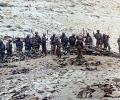
Jaishankar made these comments against the backdrop of the over five-month-long border standoff between India and China in eastern Ladakh where each side has deployed over 50,000 troops.

Union minister Kiren Rijiju on Friday said he interacted with soldiers of China's People's Liberation Army along the Sino-Indian border near Tawang during a visit to an Indian Army post on Diwali.
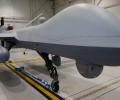
The sources said the talks are focused on sorting out certain issues relating to cost component, weapons package and technology sharing.

Following the disengagement, both sides will soon start the coordinated patrolling in their respective areas, sources added.

Air Chief Marshal Bhadauria asked the air warriors to maintain a very high-level of alertness considering the evolving situation in Pangong lake region in eastern Ladakh following China's unsuccessful attempts to occupy certain strategic points in the area, the officials said on Thursday.
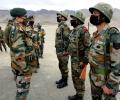
India, China have agreed to hold another round of talks soon.

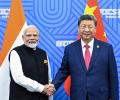
Prime Minister Narendra Modi and Chinese President Xi Jinping will hold bilateral talks on Wednesday on the margins of the Brazil, Russia, India, China, South Africa (BRICS) summit in Russia, in their first structured meeting since the eastern Ladakh border row erupted in May 2020.
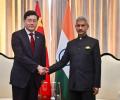
Qin's first in-person meeting with Jaishankar on Thursday came on the sidelines of the G20 foreign ministers conclave in New Delhi amid the over 34-month-long border row in eastern Ladakh.

The shelters were installed in locations near Tashigong, Manza, Hot Springs and Churup among others, in reflection of simmering tensions between the two sides in the region.

External Affairs Minister S Jaishankar and his Chinese counterpart Wang Yi met in Moscow on Thursday amid hopes of a possible breakthrough in reducing tensions along the Line of Actual Control (LAC) in eastern Ladakh.

"The Modi government's approach to the entire crisis could be described as DDLJ: Deny, Distract, Lie and Justify," Ramesh said.

China on Tuesday confirmed that it has reached an agreement with India to end the standoff between the two armies in eastern Ladakh.

The formal process of disengagement of troops began on July 6, a day after a nearly two-hour telephonic conversation between National Security Advisor Ajit Doval and Chinese Foreign Minister Wang Yi on ways to bring down tensions in the area.

There is a possibility of more talks at the military and diplomatic levels. India has always been in favour of peace. So, we hope a solution will be found out through talks, Singh said
Chinese foreign ministry spokesperson Mao Ning told the media in Beijing on Monday that the two sides held an in-depth exchange of views on expediting the resolution of relevant issues.
A day after the nearly 12-and-half-hour talks, the two sides, in a joint statement on Monday, reaffirmed that the resolution of the pending issues would help in the restoration of peace and tranquility along the Line of Actual Control (LAC) in the region and enable progress in bilateral relations.
The government needs to answer the critical question of whether it has accepted any restrictions on its infrastructure creation activities, asserts Ajai Shukla.

India recently outflanked China by taking control of strategic height near Pangong lake's southern bank.

Prime Minister Modi and President Xi held the conversation on Wednesday on the sidelines of the BRICS (Brazil, Russia, India, China, South Africa) summit in Johannesburg.

"Based on this consensus, the process of disengagement is almost complete. Our efforts will be to take the matter beyond disengagement; but for that, we will have to wait a little longer," he added.

United States Secretary of State Antony Blinken has said that he had a productive meeting with visiting External Affairs Minister S Jaishankar during which they discussed the bilateral ties, COVID-19 relief efforts, India-China border situation and Afghanistan and vowed to work together to address areas of shared concern.

The Indian Army has occupied several key heights in the strategically located Rezang-La and Reqin-La areas on the southern bank of the lake since the end of August.

As part of the mega plan, around 20 bridges, a number of tunnels, airbases and several key roads are being developed in strategically key areas in Arunachal Pradesh to bolster the overall military preparedness, officials said on Monday.
The decisions were mentioned in a joint statement issued by the two armies late Tuesday, a day after the sixth round of Sino-India Corps commander-level talks that lasted for 14-hours.
A day after the nearly 13-hour meeting, the two sides in a joint statement on Saturday reaffirmed that such a resolution would help restore peace and tranquillity along the Line of Actual Control (LAC) in eastern Ladakh and facilitate progress in bilateral relations.
The armies are working to schedule their seventh round of talks to take steps towards "early and complete" disengagement of troops along the LAC in eastern Ladakh.

Wrapping up his two-day visit to Ladakh, Gen Naravane said the Indian Army has undertaken precautionary deployment in some areas and that the force is well prepared to safeguard the territorial integrity of the country.

The last meeting between the two sides at the Corps Commander level was held in December last year.

Tan said that China has always stressed that military cooperation of relevant countries, especially on exercises and training activities, should not be targeted at any third party, but rather serve to help maintain regional peace and stability.
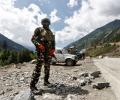
The Indian Army said the soldier, a Corporal in the Chinese People's Liberation Army(PLA), has been identified as Wang Ya Long and he will be returned to the Chinese military at the Chushul-Moldo border point after completion of formalities.

Lt Gen PGK Menon, the commander of the Leh-based 14 Corps, popularly known as 'Fire and Fury' Corps, briefed the army chief on various aspects of the situation in eastern Ladakh.

India is set to press for early disengagement of troops from the remaining friction points in eastern Ladakh at a fresh round of high-level military talks with China on August 14, people familiar with the matter said on Saturday.

In the review meeting, Singh told the top military brass to continue to deal with the situation in eastern Ladakh and other areas with "firmness".

The sources have said that patrolling will begin at these points once the disengagement that began last week is completed and both sides will move their respective troops and dismantle temporary structures.
Jaishankar said so far there was no "visible expression" of the talks on ground.
The Galwan clash occurred six months after the Doklam disengagement and two high-profile meetings. India should not be caught by surprise once again, asserts former foreign secretary Shyam Saran.

China on Thursday said the meeting between Prime Minister Narendra Modi and Chinese President Xi Jinping in Russia's Kazan on Wednesday carries a "great significance" as they reached an "important common understandings" to improve the bilateral ties.

India said it is strongly committed to ensuring its sovereignty and territorial integrity.
The Chinese military is now desperately attempting to give "ex post facto strategic meaning" to its actions in eastern Ladakh.

Lieutenant General Upendra Dwivedi, the general officer commanding-in-chief of the Northern Command, said five of the seven friction points in eastern Ladakh, where the Indian Army and the Chinese PLA are locked in a standoff since May 2020, have been resolved and talks are underway for the remaining areas.
